







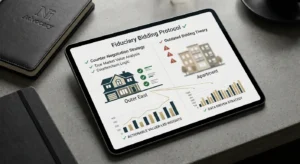
Key Insights on The 4 Pillars of Portfolio Acquisition
What is a strategic framework?
It’s a set of principles for your finances, asset selection, and management that can guide decisions in a multi-holding investment approach.
Engineer your finances
Structuring your financing and understanding your borrowing capacity is key to avoiding the lending wall. This is a central part of financial modelling.
Mandate A-grade holdings
Protecting capital by focusing on properties with a high land value and proven scarcity is crucial for long-term growth. This is where a clear investment strategy really shines.
Master the acquisition process
Using professional networks to find off-market deals and hard data to set a purchase price is a part of smart property investment.
Manage your holdings like a CEO
Regular annual assessments and the sale of underperformers can be a vital risk-mitigation tool for financiers, freeing up capital for other opportunities.
Engineer Your Finances for a Scalable Property Portfolio
An investor’s ability to expand is often determined by their financing structure, not just their income. It’s a well-known industry fact that most people never get past their first investment property. This isn’t a failure of ambition. It’s often a roadblock caused by a lending structure that wasn’t designed for successful strategic investment portfolio building. To build a collection of holdings, a financier aims to keep control of their equity and cashflow.
Avoid the Cross-Collateralisation Trap
One of the biggest mistakes that can trap people is cross-collateralisation. This is where a lender chains together different real estate holdings, using one as collateral for another lending product. This can seriously hinder growth goals.
A Tale of Two Investors: How Financial Structure Determines Success
Let’s imagine two investors, each with two properties worth $1M each, who want to buy a third as part of their wealth-creation approach.
-
Investor A (Incorrect Structure) Has their holdings cross-collateralised with one bank. When they go to sell one to access the profit, the bank revalues their entire collection in a falling market. The bank then freezes their equity to protect its position, leaving the person unable to sell or make a new purchase. They're trapped.
-
Investor B (Correct Structure) Has two standalone financing arrangements. They sell one holding and have full, immediate access to their profit. They use this cash as a deposit to purchase two more A-grade acquisitions, accelerating their multi-asset investment from two holdings to three. They're kicking goals.
Mastering Your Borrowing Capacity and Financing Approach
To be like Investor B, one might consider three key financing principles with their mortgage broker. This forms a core part of the financial modelling for their property collection. Smart planning at this stage is what separates amateur accumulators from professional investors.
| The Principle | The Actionable Advice |
|---|---|
| Use Standalone Financing: Each acquisition has its own separate mortgage, giving the owner full control over their equity. | If a bank insists on chaining financing together, it may not be the right growth partner. A good broker can find a lender with flexible, investor-friendly products designed for growth. |
| Use Interest-Only Loans with an Offset: This can improve cash flow and borrowing power during the growth phase as you build your holdings. | Directing surplus income into an offset account can reduce net debt while keeping the money fully accessible for future deposits. This is a savvy way to manage your finances. |
| Maintain a Cash Buffer: Keeping at least 20% of total lending power in reserve is a common safety net for astute financiers. | This buffer acts as a shield against interest rate rises or unexpected vacancies. It's rarely worth risking an entire portfolio for a single deal, and it provides crucial peace of mind. |
Mandate A-Grade Assets for Long-Term Growth
With finances structured for growth, energy can shift to property selection. A collection of properties is only as strong as its weakest link. A commitment to A-grade properties is a method to protect money and let compounding do the heavy lifting. The process of buying the right investment properties is paramount. From our professional opinion, an A-grade holding should pass these three simple checks.
Putting It Into Practice: A Tale of Two Properties and Suburb Selection
The Land-to-Asset Ratio is one of the most important checks in any acquisition. Effective property selection, which includes detailed suburb selection, is critical. Let’s see why.
-
Property A (A-Grade) An older house on a good-sized block in an established suburb with strong infrastructure and school zoning, bought for $1,000,000.
-
Land Value $700,000 (70%)
-
Building Value $300,000
-
The Verdict This is a powerful A-grade holding. The value is in the land, which appreciates over time. The building provides rental income, but the land does the heavy lifting for financial growth.
-
Property B (B-Grade) A brand new house in a new housing estate on the city fringe, also bought for $1,000,000.
-
Land Value $400,000 (40%)
-
Building Value $600,000
-
The Verdict This is a B-grade holding disguised as a premium acquisition. Most of the money is tied up in the building, which depreciates. It will struggle to achieve the capital growth needed to fund the next purchase and will likely underperform in the market cycle.
Ready to build your A-grade portfolio?
Let our experts create your custom acquisition plan. Book your free strategy session to learn how we can help you start your journey now.
Master the Buying and Acquisition Process
Knowing what to purchase is half the battle. The other half is finding and securing it at the right price. Relying on major real estate websites means competing with everyone for a small fraction of what’s truly for sale. A successful multi-investment approach often requires a smarter way of buying.
Gain Access to Off-Market Opportunities
“Off-market access” simply means a top agent calls a potential buyer before a listing is made public. They do this for a quick, quiet sale to save on marketing costs. To get that call, it helps to be known as a finance-ready buyer, a key advantage in any negotiation.
-
Insider Tip: An investor can engage a Buyer's Agent who already has these critical relationships. They're not just paying for their time. They're paying for their network. This is a key part of an effective property investment approach.
Anchor Your Offer to Hard Data, Not Price Guides
An agent’s price guide isn’t a marketing tool, it’s a financial analysis. Anchoring an offer in hard data is a fundamental aspect of risk mitigation for financiers seeking to avoid overpaying for an investment property.
-
The Solution: It's possible to get an independent valuation from a Certified Practising Valuer. A valuer is legally liable for their assessment. An agent isn't. This report provides a firm price ceiling for negotiation. It’s one of the best tools for protecting your money and making a smart offer, ensuring you secure a strategic property.
Active Management & Portfolio Review
Securing an A-grade holding is the start, not the finish line. The phrase “buy and hold” shouldn’t mean “buy and forget.” Professionals often treat their investments like a business, and that means active management. An annual portfolio review is non-negotiable for serious people aiming for growth.
The 80% Performance Rule: A Key Risk Mitigation Tool
Let’s imagine an investor owns an investment that fails the 80% rule for two straight years. The suburb’s median price grew by 10% ($100,000), but their holding only grew by $550,000). This is where a portfolio strategy becomes crucial.
-
The Inaction Cost By holding on, they're missing out on $50,000 of growth every year compared to the market average. Over five years, that's a $250,000 opportunity cost. That "lazy money" is preventing them from achieving their goals. A good portfolio balance is essential.
-
The Smart Action A professional often sees the data and decides to sell. After paying Capital Gains Tax, they can reinvest the remaining capital into a new A-grade holding. This single decision is a powerful risk-mitigation measure that unlocks their "lazy money" and puts them back on the path to a six-property portfolio. This is smart portfolio sequencing.
From Property Collector to Portfolio Engineer
High-performance portfolios aren’t built by luck: they’re engineered with intent. This system is for replacing guesswork with certainty. Understanding these four pillars is a way to systematically reduce risk and build the foundation needed for a secure financial future, helping you surpass your initial targets.
Adopting this methodology is the first step toward becoming a true portfolio engineer. If you need help with the technical details of your multi-investment plan, we can provide the clarity you need for your property investment journey.
Investor FAQs
The borrowing wall is avoided by implementing a specific financial structure, not by simply increasing your income. The primary solution is using standalone financing for each acquisition. This approach gives you full control over individual equity holdings, allowing you to sell or refinance one holding without affecting the others. This contrasts sharply with cross-collateralisation, where a lender links your real estate, often freezing your equity when you need it most. For optimal growth, combine standalone financing with an interest-only structure and an offset account to protect your cash flow.
While it may seem counterintuitive, a strategically engineered collection of 6+ holdings can be less risky than holding just one or two. The risk is mitigated through three core principles. First, mandating A-grade acquisitions with a high Land-to-Asset Ratio ensures you own fundamentally valuable, scarce land. This is the foundation of any solid property investment. Second, maintaining a significant cash buffer helps absorb financial shocks, such as interest rate rises. Third, diversifying across different areas protects you from a single market's downturn. This contrasts with the concentrated risk of having all your capital in one or two acquisitions in the same location.
A calculated sale is a critical management tool. The modern approach is 'buy and manage,' not 'buy and forget.' A common strategy is to conduct an annual assessment against a clear benchmark, such as the 80% Performance Rule. If a property consistently fails to achieve at least 80% of its suburb's median growth, it becomes a candidate for sale. The decision involves a clear trade-off between holding a comfortable but underperforming property ('lazy money') and selling to redeploy that capital into a new A-grade investment with higher growth potential. The opportunity cost of holding a 'dud' investment property can significantly slow your journey to building a larger portfolio.
Disclaimer: The information provided in this article is for general informational purposes only and does not constitute financial, investment, or legal advice. It represents our professional opinions and has been prepared without regard to your personal objectives, financial situation, or needs. The property market is subject to risks, and past performance is not indicative of future results. Before making any investment decision, you should conduct your own research and consider seeking independent professional advice from a licensed financial advisor, accountant, or lawyer.
Ni Advocacy
Melbourne Buyers Agency
Need help with your portfolio strategy?
Get a free, valuer-led strategy plan to start building your high-value holdings.

