







Key Takeaways
Focus on Asset Value, Not Quantity
Your goal is a specific portfolio value (your ‘Freedom Number’), not a specific number of properties.
Calculate Your ‘Freedom Number’
Use your desired annual income and a conservative net yield to determine your target asset value.
A-Grade Assets are Non-Negotiable
Prioritise properties with a high Land-to-Asset Ratio to ensure strong capital growth, which fuels your portfolio expansion.
A Data-Driven Strategy is Crucial
A clear, phased plan for acquisition and consolidation is the only reliable way to build a retirement-ready portfolio and avoid getting stuck.
Calculating Your Retirement Income, The ‘Freedom Number’
A better approach is to calculate your ‘Freedom Number’: the total net asset value you need to generate your desired annual retirement income.
The Formula
Your Freedom Number = (Desired Annual Income) / (Net Rental Yield)
Example Calculation
Let’s say you want a comfortable retirement income of $100,000 per year.
Assuming your property portfolio generates a conservative 3.0% Net Yield (rental income after all expenses), the calculation would be:
Your Freedom Number = $100,000 / 0.03 = $3,333,333
This means you need a clear, debt-free property portfolio valued at approximately $3.3 million to achieve your income goal. Your strategy should be built around reaching this asset value, not an arbitrary number of properties.
Why Asset Quality is More Important Than Asset Quantity
It’s not about how many properties you own; it’s about the quality and performance of the assets you hold. An investor with three high-growth, A-Grade houses will be in a far stronger position than an investor with ten B-Grade apartments that have stagnant growth and high holding costs.
The A-Grade Litmus Test Using the Land-to-Asset Ratio
The Land-to-Asset Ratio is a simple metric for assessing a property’s investment quality. It measures how much of the property’s total value is in the land itself. An accurate Land-to-Asset Ratio assessment is crucial, which is why working with a certified valuer and buyer’s agent provides a significant advantage.
Land-to-Asset Ratio = (Value of the Land) / (Total Market Value of the Property)
A-Grade houses typically have a high Land-to-Asset Ratio (often over 75%), meaning most of their value is in the appreciating land, not the depreciating building. This makes them a powerful growth asset.
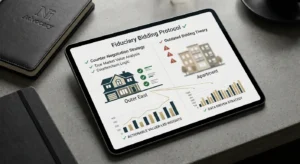
Positive Example: A-Grade House
-
Total Value: $1,000,000
-
Land Value: $750,000
-
Land-to-Asset Ratio: 75% (High Growth Potential)
Negative Example: B-Grade Apartment
-
Total Value: $500,000
-
Land Value: $100,000
-
Land-to-Asset Ratio: 20% (Low Growth Potential)
Stop Guessing and Start Building a Data-Driven Portfolio
Feeling uncertain about your next investment? Our expert team removes the guesswork. We combine rigorous data analysis with a Certified Valuer’s precision to find A-grade properties primed for growth.
The 3-Phase Strategy to Reach Your Freedom Number
Building a multi-million dollar portfolio doesn’t happen overnight. It requires a structured, three-phase approach: Acquisition, Consolidation, and Lifestyle.
-
Phase 1: Acquisition (The Growth Phase) This initial phase is focused on acquiring A-Grade growth assets. Using equity from one property, you can create deposits for the next, systematically building your portfolio’s value.
-
Phase 2: Consolidation (The Peak Debt Phase) Once your portfolio matures and you approach your ‘Freedom Number’, you transition to a consolidation phase. This involves paying down debt, potentially selling a lower-performing asset, and optimising your portfolio. This is an ideal time for a professional property portfolio review to identify and address any underperforming assets.
-
Phase 3: Lifestyle (The Retirement Phase) With your portfolio debt-free (or with very low debt), you begin to draw an income from the rental yields, funding your retirement lifestyle.
A Hypothetical 15-Year Journey
Let’s visualise this journey to a $3.3M portfolio:
-
Years 1-5: Acquisition You purchase Property 1 (an A-Grade house). Through capital growth, you extract equity to use as a deposit for Property 2.
-
Years 6-10: Continued Acquisition & Growth Your portfolio value continues to climb. You use the combined equity from Properties 1 and 2 to acquire Property 3. Your asset base is now significant and experiencing strong compound growth.
-
Years 11-15: Consolidation & Preparation Your portfolio has now reached your target ‘Freedom Number’. You stop acquiring new properties and focus on aggressively paying down debt to prepare for retirement.
The Biggest Mistake Investors Make And How to Avoid It
The most common failure point is getting stuck at one or two properties and never moving forward. The Australian Taxation Office (ATO) statistics consistently show that over 70% of property investors own only one investment property, and nearly 90% own two or fewer.
This is usually due to two preventable strategic errors:
-
Buying Poor Quality Assets A B-Grade property with low growth potential will never generate enough equity to help you buy the next one.
-
Lacking a Clear Plan Without a clear financial roadmap, investors make emotional decisions, buy in the wrong locations, or simply don't know what their next step should be.
That’s why a data-driven strategy is non-negotiable.
Frequently Asked Questions
For high-growth capital-city houses, a net yield of 2.5% to 3.5% is typical. While higher yields are possible in other areas, they often come at the cost of lower capital growth, which is the engine of your portfolio’s expansion.
This depends on market conditions, your starting financial position, and your risk tolerance. A 15-20 year timeframe is a realistic expectation for building a substantial, retirement-ready portfolio from scratch.
Cheaper properties are almost always B-grade or C-grade assets with low growth potential and higher risks (e.g., tenant vacancies, maintenance issues). They won't generate the equity needed to expand your portfolio and will likely become a long-term financial burden.
Disclaimer: This article is for informational purposes only and doesn’t constitute financial advice. All investment decisions should be made in consultation with a qualified professional. Figures are estimates and subject to market conditions.
Ni Advocacy
Melbourne Buyers Agency
Ready to Build Your Own Financial Roadmap?
Stop guessing and start building. Let our experts build your personalised plan to reach your Freedom Number with A-Grade properties. As Certified Valuers and expert Buyer’s Agents, we give you the data-driven advantage you need to succeed.

